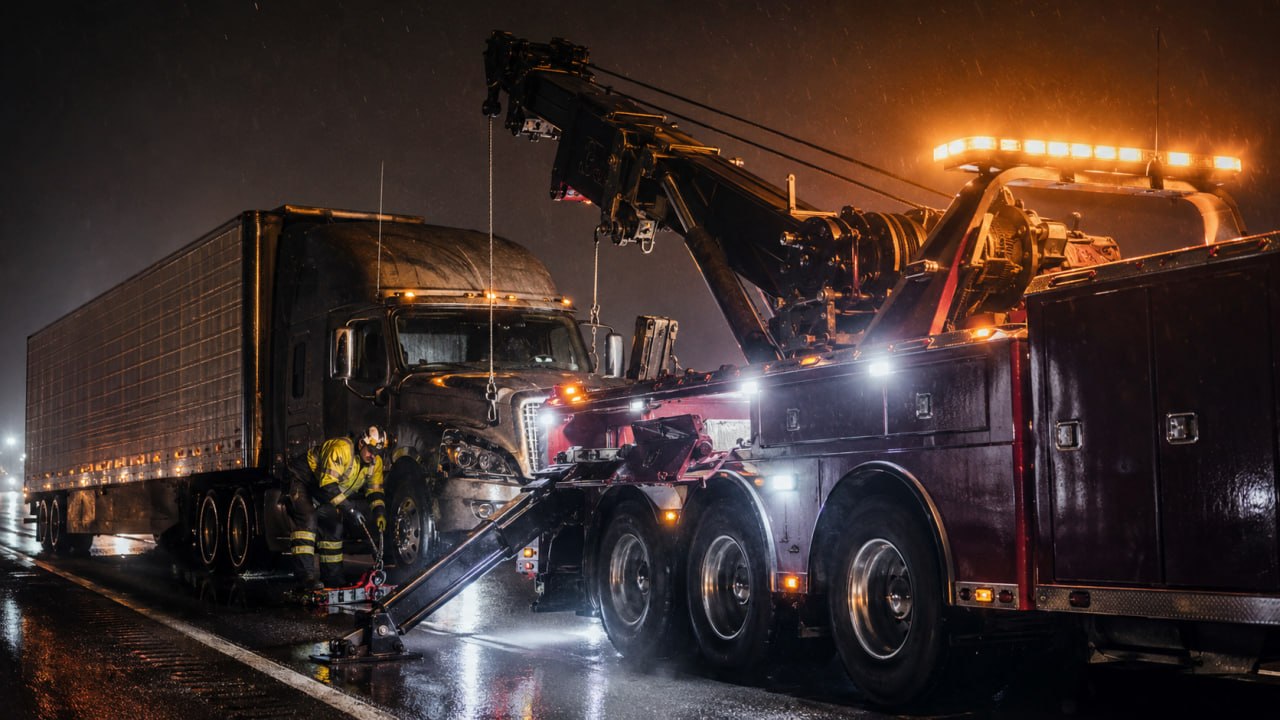
The Dallas / Fort Worth Metroplex is one of the busiest freight corridors in the United States. I-35, I-20, I-45, and the LBJ Freeway carry millions of commercial vehicle miles every year — which means breakdowns are a daily reality for the drivers and fleet operators working these routes. When it happens to you, knowing exactly what to do makes the difference between a manageable delay and a serious incident.
This guide walks you through the correct sequence of actions when a semi truck or commercial vehicle breaks down in the Dallas / Fort Worth area — from immediate safety steps through cargo protection and getting back on the road as quickly as possible.
Stay Safe First — Move Off the Road Immediately
The first priority when a semi breaks down on a Dallas highway is not the truck — it's the driver's safety. The DFW Metroplex has some of the highest commercial vehicle traffic density in the country. I-35, I-20, I-45, and I-635 all carry enormous volumes of freight traffic at speed, and a stopped semi is an extreme hazard.
If at all possible, get the truck and trailer fully onto the shoulder or, better yet, off the highway entirely to a rest area, exit ramp, or commercial parking area. Put on all hazard lights immediately. Set reflective triangles or flares at 10 feet, 100 feet, and 200 feet behind the vehicle per FMCSA regulations.
FMCSA Breakdown Requirements
Federal Motor Carrier Safety Administration regulations require that drivers place warning devices within 10 minutes of stopping on a roadway. Three reflective triangles must be placed at 10 feet behind the vehicle, 100 feet behind, and 100 feet ahead. Failure to do so creates liability in the event of a secondary accident.
Assess the Situation — Don't Attempt Unauthorized Repairs
Once you're safely stopped, assess what's happened. The most common semi-truck breakdowns on Dallas highways include blown tires, engine failures, brake problems, electrical failures, and fuel issues. Some of these can be resolved with roadside assistance. Others require a heavy duty tow.
Here's the critical judgment call: do not attempt to drive a truck that has experienced a serious mechanical failure. A semi with brake problems, a blown steer tire, or an overheating engine that continues down the highway is a danger to everyone on the road. If there's any doubt about the mechanical integrity of the vehicle, call for heavy duty towing immediately.
Who to Call — And in What Order
Once you've assessed the situation and ensured your safety, here's the right order of calls:
- Dispatch/Fleet Manager first — your company needs to know immediately for load management, customer notification, and insurance purposes
- Heavy duty towing company second — call a towing company that specifically handles commercial vehicles. A standard light-duty tow truck cannot handle a loaded semi. In the DFW area call (214) 833-8676 for immediate dispatch.
- Insurance carrier third — get the claim started immediately. Most commercial policies have roadside assistance provisions that may cover towing costs.
- Shipper/Receiver if cargo is time-sensitive — give them an honest estimated delay so they can plan accordingly
If you're an owner-operator without a dispatch to call, the towing company becomes your first call. A good heavy recovery operation can often coordinate with your load broker and insurance carrier as part of the service.
Broken Down in Dallas / Fort Worth?
Our dispatch team responds 24/7 to commercial breakdowns across the DFW Metro. Call now for immediate heavy duty towing.
📞 Call (214) 833-8676What to Tell the Towing Company
When you call for heavy duty towing, having the right information ready speeds up response time and ensures the correct equipment is dispatched. Tell them:
- Your exact location — highway number, direction of travel, nearest mile marker or exit number. In DFW, landmarks like "I-35W northbound near exit 54" are more reliable than street addresses.
- Type of vehicle — make and model of the tractor, whether you have a trailer attached, trailer type (flatbed, dry van, reefer, tanker, etc.)
- Loaded or empty — a loaded 80,000 lb combination requires different equipment than an empty bobtail
- Nature of the breakdown — blown tire, engine failure, accident, rollover, stuck/off-road
- Any hazmat placards — absolutely critical information that changes the response entirely
Protecting Your Cargo During a Breakdown
If you're carrying a load, cargo security becomes an important consideration during a breakdown. For refrigerated loads, note the time your reefer unit failed and document the temperature. For high-value freight, your carrier's cargo insurance may require you to stay with the vehicle or take specific precautions.
A professional heavy recovery operation understands cargo liability. Our team works alongside cargo owners and insurance adjusters to document conditions and coordinate cargo transfer when necessary during accident recovery and breakdown situations.
Frequently Asked Questions
Can a regular tow truck tow a loaded semi in Dallas?
No. A standard light-duty or medium-duty tow truck does not have the capacity to tow a loaded 18-wheeler. Loaded combination vehicles can weigh up to 80,000 lbs and require heavy duty wreckers specifically equipped for commercial vehicle recovery. Always call a company that explicitly handles heavy duty towing.
What should I do if my semi breaks down on I-35 in Dallas at night?
Get fully off the road if possible, activate hazard lights immediately, set out reflective triangles per FMCSA regulations, stay in the cab or well off the road away from traffic, and call a 24/7 heavy duty towing company. Do not stand between your vehicle and oncoming traffic. Call (214) 833-8676 for immediate 24/7 response across the DFW Metro.
How long does heavy duty towing take to arrive in Dallas?
Response times vary by location and current demand, but in the Dallas / Fort Worth Metro Area a well-equipped heavy duty towing company should be able to respond within 30-60 minutes for most locations. Rural areas may take longer. Having the correct information ready when you call — location, vehicle type, nature of breakdown — helps dispatch the right equipment immediately and reduces total response time.
Broken Down in Dallas / Fort Worth? Call Us Now.
Our heavy duty towing and recovery team is available 24/7 across the Dallas / Fort Worth Metro Area including all major highway corridors. One call gets the right equipment moving to your location immediately.